What’s on my Nightstand: March 2019

Nonfiction

Deep Creek: Finding Hope in the High Country, by Pam Houston

The Way of Chuang Tzu, by Thomas Merton

Era of Ignition, by Amber Tamblyn

From Dictatorship to Democracy, Gene Sharp 

The Methods of Nonviolent Action, by Gene Sharp

Occasional Magic – The Moth (True Stories About Defying the Impossible)

Fiction

The Queen of the Night, by Alexander Chee

Before She Was Harriet, by Lesa Cline-Ransome

Short Fiction

‘The Office of Missing Persons’ by Akil Kumaraswamy (Lit Hub)

‘The Frog King,’ by Garth Greenwell (The New Yorker)

‘Motherland,’ by Min Jin Lee (The Missouri Review)

Poetry

Elizabeth Bishop, The Complete Poems: 1927 – 1979

Enough Music, by Dorianne Laux

Goodbye to Tolerance, by Denise Levertov

Essay / Interview / OpEd (Selected)

The Phenom: ‘Change Is Closer Than We Think.’ Inside Alexandria Ocasio-Cortez’s Unlikely Rise,’ by Charlotte Alter

8 Short Kids’ Films Every Mini-Feminist Should See, by Emma Davey

Thesomorphia, by Melissa Febos

The Thread: Down Girl (The Rumpus) by Marissa Korbel

Against Catharsis: Writing is Not Therapy, by T Kira Madden

Voices of Addiction: All the Ways to Save Your Life,(The Rumpus) by David M. Olsen

Patti Smith discusses activism in the age of Trump: ‘I’m not going down with the ship, that’s for certain’ by Randall Roberts

AACK! Cathy Guisewite made a wildly successful comic strip by and for women. But to her critics, she’s just another example of compromised feminism by Rachel Syme

Magazine / Newspaper

Lesbian Connection: free to lesbians worldwide, but the suggested donation is $7/issue (more if you can, less if you can’t), January/February 2019 issue

The New Yorker

The Week

TIME

SIERRA Magazine

Random

booda butter – naked lip balm

El Sueño Americano (The American Dream) – exhibition card, Tom Kiefer

abalone shell, palo santo wood, dried rose buds

Chill Pill – Aura Cacia Essential Oil Blend

necklace (shells, leather suede), Little Green Apple Jewelry

beach stones

Mexican tile (coaster)

About

3.5 % Project

Publications

Postage

Teaching

Method 31: “Haunting” Officials

Sometimes I wonder what it will feel like to read these posts in 5 or 10 years. Honestly, I started the this project because I needed to do something with the daily barrage of overwhelmingly bad news. In a short time, it’s becoming a record of how much we’re all managing on a daily basis.

I am doing this because we are NOT helpless.

These methods work.

Method 31: “Haunting” Officials was used in India 1928 during the Bardoli Satyagraha, a peasant-led campaign of civil disobedience. In response to the government’s unresponsiveness to widespread famine, farmers, peasants, and other volunteers “haunted” government officials. They camped out in the roads in front of their homes in silence. When the activists were arrested, they were immediately replaced by others. Eventually, authorities tired of the process. Members of the governments of Bombay and across India were furious about the treatment of the protesting farmers and resigned from their offices in open support of the farmers.

Yesterday in New Zealand, citizens gathered in silent protest outside Gun City, a gun store that sells the military-style semi automatic reportedly used by the man responsible for the massacre in Christchurch. Prime Minister Jacinda Ardern’s response to the massacre puts other leaders to shame:

“She fought from the start like a real politician, scorning the killer, attacking racism and slapping back at Turkish president Erdogan’s revolting election propaganda – which used the murderer’s own video – then hitting out at US president Trump. And insisting that New Zealand’s gun laws would change forever.”– Robert Fisk, Independent

Got a tent? Pitch it here.

I’ll bring snacks.

Mueller, please hurry up.

3.5% Project

About

Publications

Subscribe

Method 30: Rude Gestures

Wasn’t Method 29 a breath of fresh air? Today’s must-watch video of Anderson Cooper is not that. The piece below aired last week, but in today’s news cycle, it’s already old news. That’s the danger of the time we’re in. Paul Manafort is up for sentencing today, 45 is already tweeting about campaign contributions and the wall, and in the meantime in North Korea:

Satellite images appear to show the North is rebuilding a facility that had been previously used to test long-range missile engines. Analysis of the images suggests the work on the facility, which had been dormant since August, began right around the time Donald Trump and North Korean leader Kim Jong Un met up for their second summit, which ended last week without an agreement. 

– via CNN, March 6, 2019

Watch Anderson Cooper’s response to 45 calling Kim Jong-un, the leader of the world’s most repressive dictatorship, “my friend,” “an interesting guy” and a “real leader.” North Korea – the country where failing to keep the presidential portrait dust-free is a punishable offense.

This offers some context for Professor Gene Sharp’s warning that Method 30 should be used only rarely in situations of political or international conflict. What would happen if North Koreans mooned Kim Jong-un’s palace, like Trump’s protestors did in Chicago? By law, three generations of a protestor’s family could be sent to labour camps.

In September 2017, The Telegraph provided a concise list of “brutal and inhumane laws North Koreans are forced to live under.” I’ve provided a condensed version, below:

Three generations rule

In North Korea, if one person is convicted of a serious crime and sent to a prison camp, their immediate family can also be sent with them. Then the next two generations born in the camps can also remain there. The 1972 edict says that up to three generations must be punished to wipe out the ‘seed’ of class enemies.

Access to non-state-controlled media

Listening to unauthorized foreign broadcasts, watching foreign TV shows and possessing dissident publications are considered “crimes against the state.” Those caught face execution or being sent to labour camps.

Freedom of movement

It is a criminal offense for North Koreans to leave the country without government permission. That doesn’t stop thousands making highly treacherous journeys in attempts to escape every year. Even those who successfully make it out of the North can still be pursued by government agents and there are reports of defector’s families being punished in their absence.

Practising Christianity

Although the North Korean constitution officially allows freedom of religion, the state has a hostile approach to religions, particularly to those it sees as western faiths such as Christianity. Those discovered practicing Christianity face arrest and being sent to a labour camp. (I wonder how the half of pastors who approve of Trump feel about the endorsement of Kim Jong-un?)

Economic rights

Private enterprise of any kind is officially banned in North Korea. Those caught face arbitrary punishment even though the black market remains one of the only ways for people to get the food, medicine and other necessities the government often fails to provide. 


Mueller, please hurry up.

3.5% Project

About

Publications

Subscribe

Method 29: Symbolic Reclamations

Today’s method is a hopeful one! Sometimes it’s called “Planting in Protest.” When public land has been seized or neglected, protestors plant trees, seeds, or plants in places where the existing or future policies are a threat to the environmental health of that area.

In Africa, eleven countries are building a “Great Green Wall” from east to west coast to reverse desertification.

After Trump withdrew the US from the Paris Agreement, a New Zealand group called Trump Forest began accepting pledges to plant trees, because every tree helps to reduce carbon from the atmosphere. To date, Trump Forest has planted over 500,000 trees and has collected pledges from more than 100 countries. Author Margaret Atwood is a supporter.

Neighbors in British Colombia, Canada formed an organization called PIPE UP to restore the local ecosystem after the construction of a pipeline.

An NGO in Costa Rica called “Community Carbon Trees” is working with rural community members to reforest portions of the rainforest with indigenous trees. “Our goal is to get as many hands on desk as we can, because we really do have a solution to the problem.

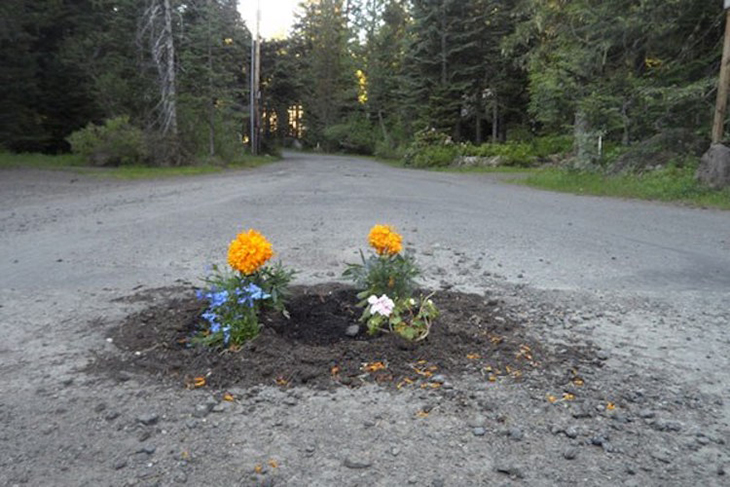
Across North America and parts of Europe, people are fed up with their complaints about neglected roads going unanswered. To get the attention of local municipalities, they fill street potholes with potting soil and flowers. Here’s are a few shots from Portland, Oregon – because Portlanders.

A Great Green Wall?

Spring’s just around the corner…

Method 28: Symbolic Sounds

NOTE: Today’s post comes with a challenge, so feel free to skip to the hashtag at the end.

Way back in July 2018, Trump returned to the White House after a summit with Putin during which he refused to denounce any Russian interference in the 2016 election. Former Clinton advisor Adam Parkhomenko took to Twitter in protest.

In less than 30 minutes, a crowdfund campaign covered the costs for a mariachi band to play outside the White House during a night when Trump was already jet lagged. The concert went on to become part of a multi-day protest called Occupy Lafayette Park:

Is it me, or do the mariachi days of July seem cheerfully naive in light of this week’s reports that migrant children are being handcuffed and transferred to adult detention centers on their 18th birthdays? While “weaponizing” mariachi bands, opera singers and bagpipers may seem harmless, the use of oral or mechanical sounds has been used throughout history to convey a message during oppressive regimes.

In May 1917, the French army had already staged mutinies against the government, but when some units were forced to return to the trenches, the soldiers began “baaing” in protest, to signify that they were lambs to the slaughter. “The officers were helpless to prevent it.” (Source: The Methods of Nonviolent Action, Part Two, Gene Sharp.)

In 1968, in protest of forcible occupation, Czechoslovakian bishops called on churches to ring funeral bells. Soon, the city filled with the sound of sirens, car horns and train whistles. Soviet troops were so unnerved that they drew their pistols, terrified that an attack was about to begin.

#InternationalMargaritaDay

Today, on what is apparently #InternationalMargaritaDay, imagine what would happen if we used that hashtag to enlist the resistance to blare our car horns in time to “Impeach the President” on the hour, every hour for the next week? Or month? Or until 2020?

As my beloved Lidia Yuknavitch says, “we are nothing without each other.”

Impeach the President” is a single by funk band The Honey Drippers, released on Alaga Records in 1973 and re-released to iTunes by Tuff City Records in 2017, after being sampled many times. The protest song advocates the impeachment of then president Richard Nixon.

“Impeach the President”

Ladies and gentlemen
We have the Honey Drippers in the house tonight
They just got back from Washington, DC
I think they got somethin’ they want to say

[Verse 1]
Some people say that he’s guilty (that he’s guilty)
Some people say I don’t know (I don’t know)
Some people say, give him a chance (give him a chance)
Aw, some people say, wait till he’s convicted (till he’s convicted)

[Chorus]
Impeach the President

[Interlude]
Impeach the President
(Aw nah, we can’t do that, man—nah, nah)

Impeach the President (Shut up, fool!)
Impeach the President

3.5% Project

About

Publications

Subscribe

A Very Mueller Valentine’s Day

Ukulele Challenge: Part III “A Very Mueller Valentine’s Day”

Who can turn the world on with one file?
Who can take an endless case and suddenly make it all seem worthwhile?
Well it’s you, Bob, and you should know it
With each glance and every little news breaking moment
The truth is all around, no need to worry
Still I have to say, we wish you’d hurry
You’re gonna make it after all
You will convict him after all

(doo-doo-doo-doot-doo)

(Method 37)

3.5% Project

About

Publications

Subscribe

“Researchers used to say that no government can survive if just 5% of its population rose up against it, but what the research showed is that no single campaigns failed during the time period after they’d achieved the active sustained participation of just 3.5 percent of the population.” – Erica Chenoweth

Method 27: New Signs and Names

Before I move on to Method 27, two words:

Brandy Carlile.

61st Annual Grammy Awards, Show, Los Angeles, USA - 10 Feb 2019
Photo by Rob Latour/REX/Shutterstock (10095018ic) Brandi Carlile 61st Annual Grammy Awards, Show, Los Angeles, USA – 10 Feb 2019

Carlile’s performance of “The Joke” at last night’s Grammy awards has been on repeat all day. It’s one of the most powerful, timely performances I’ve seen, and I just can’t get it out of my head. Watch the performance.

They come to kick dirt in your face
To call you weak and then displace you
After carrying your baby on your back across the desert
I saw your eyes behind your hair
And you’re looking tired, but you don’t look scared

Artists are leading the revolution.

Method 27: New Signs and Names

IMG_5203Method 27 can take many forms, but the approach is to take signs that have been used against people and to turn them into something new. The signs can be repurposed, they can disappear or be replaced with something new.


When I was researching this method, I came across today’s LA Times, “Last of iconic illegal immigration crossing signs has vanished in California.” After years of debate, the last of 10 yellow “immigrants crossing” signs that once stood on either side of the 5 and 805 freeways near the U.S.-Mexico border disappeared. The department of transportation stopped making the signs and constructed fences to prevent people from crossing highways instead. (See slideshow, below.)

Method 27 was used in 1942 in occupied Poland by a group of young resistors who called themselves “The Little Wolves.” They stole the signs reading “Nur Für Deutsche” (FOR GERMANS ONLY), signs that were posted in front of Warsaw’s best cafes, hotels and theaters. One morning, hundreds of the signs reappeared on city’s lamp posts and trees where the Germans often hung Polish patriots. Overnight, street signs, placards and inscriptions throughout the city were replaced with the names of the heroes of the revolution.

I featured the artist Banksy in Method 26: “Paint as Protest,” and he’s back again today. A warning that the images in the slideshow below are triggering, but they end on a note we can all live by. I recommend listening to Brandi Carlile as you watch. [Listen.]

Let ’em live while they can
Let ’em spin, let ’em scatter in the wind
I have been to the movies, I’ve seen how it ends
And the joke’s on them.

This slideshow requires JavaScript.

3.5% Project

About

Publications

Subscribe

“Researchers used to say that no government can survive if just 5% of its population rose up against it, but what the research showed is that no single campaigns failed during the time period after they’d achieved the active sustained participation of just 3.5 percent of the population.” – Erica Chenoweth

Method 26: Paint as Protest

Tuesday night’s State of the Union was a gorgeous example of the effectiveness of Nonviolent Method 18. The sea of Congresswomen in white couldn’t be overlooked – not by the viewing audience and especially not from the podium.

This slideshow requires JavaScript.

The rest of the SOTU caused me to flip between CNN and old episodes of Survivor after my partner asked, “Are you really going to curse at the screen every fifteen seconds?” (Answer: “F*&K YES … the likes of which has never been seen!!!”)

Former CIA Director John Brennan, a frequent critic of 45, said this of the State of the Union address: “I think Donald Trump raised to a new level,” he said, “the demagoguery, the hyperbole, the chauvinism, and even the misrepresentation on a lot of the issues, including on the foreign policy and national security front.”

For more on how how the rhetoric of dictators can bring down democracies, check out this article.

Method 26: Paint as Protest

Paint as a tool of nonviolent resistance can take many forms – as graffiti, on buildings, walls, or bodies, or symbols drawn on official portraits. In August 2017, graffiti resembling the work of the illusive artist Banksy appeared on Israel’s security barrier in the West Bank city of Bethlehem.

In June 2018, six new murals appeared in Paris to protest the French government’s anti-refugee policies. The first image in the slideshow below depicts a young girl spraying a pink wallpaper pattern over a swastika on a wall next to her sleeping bag and teddy bear in an attempt to make her patch of pavement more homelike.

This slideshow requires JavaScript.

Art historian Paul Ardenne said it does not matter if the murals are by Banksy, but they do “show that the Banksy effect, and its ability to manipulate the media, works.”

3.5% Project

About

Publications

Subscribe

“Researchers used to say that no government can survive if just 5% of its population rose up against it, but what the research showed is that no single campaigns failed during the time period after they’d achieved the active sustained participation of just 3.5 percent of the population.” – Erica Chenoweth

What’s on my Nightstand: January 2019

Nonfiction

Riot Days, by Maria Alyokhina

Brazil, by Elizabeth Bishop and LIFE Magazine (1962)

Beautiful Country Burn Again: Democracy, Rebellion, and Revolution, by Ben Fountain

From Dictatorship to Democracy, Gene Sharp *

The Body Keeps the Score: Brain, Mind, and Body in the Healing of Trauma, by Bessel A. van der Volk

Dear America: Notes of an Undocumented Citizen, by Jose Antonio Vargas

* NOTE: on Wednesday, January 31, Gene Sharp passed away peacefully in his home at the age of 90. Professor Sharp is the author of the research and works that sparked the 3.5% Project.


Fiction

Florida, by Lauren Groff


Short Fiction

“Death Constant Beyond Love,” by Gabriel García Márquez

“Cream,” Haruki Murakami


Poetry

Elizabeth Bishop, The Complete Poems: 1927 – 1979

“Resignation,” by Nikki Giovanni

“Knots,” by RD Laing

“Good Bones,” by Maggie Smith


Journal

Granta

The Paris Review, No. 227, Winter 2018


Essay / Interview / OpEd

“The Quiet American,” by Janine Di Giovanni, The New York Times

The Racist, Homophobic Attack on Jussie Smollett Is Far-Right America’s Endgame, by Joshua Rivera, GQ Magazine

“The Thread: Fatherless,” by Marissa Korbel, The Rumpus

“Teaching my daughter that love is love,” by Vanessa Martir, The Washington Post

“The Radicalization of Bedtime Stories,” by Joe Pinsker, The Atlantic


Catalogue

Mt. Airy Learning Tree Winter 2019 Course Catalogue


Magazine / Newspaper

Lesbian Connection: free to lesbians worldwide, but the suggested donation is $7/issue (more if you can, less if you can’t), January/February 2019 issue

The New Yorker

The Week


Random

HURRAW! moonbalm

worry stone, glass

Mexican tile (coaster)

Pixel computer glasses

Smith’s Rosebud Salve


About

3.5 % Project

Publications

Postage

Teaching


Method 25: Displays of Portraits

I need you to know about Marielle Franco.

On March 14, 2018, the Brazilian LGBT and human rights activist was assassinated  in what many believe was a targeted political attack. After leaving a public meeting, two cars followed the councilwoman’s car, pulled up behind, and shot her through the window.

Ten months later, her murderer has not been found.

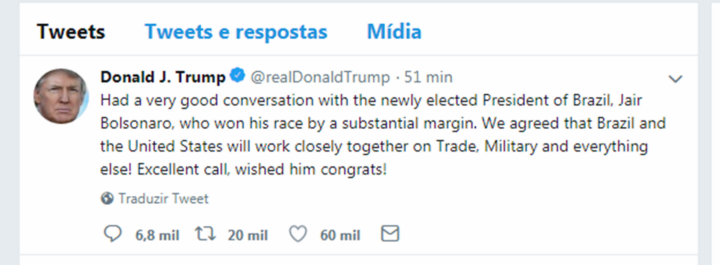
Crimes like these increase in places where the divisions around race, class, gender and sexual orientation are stigmatized. There is little hope that the police investigation of Franco’s homicide will continue, because on October 28, 2018, far-right congressman Jair Bolsonaro was elected president. This is a man who said that if his son was acting “gayzinho” (a little gay), he would beat him.

This is the man who has been called “The Trump of the Tropics.”

trumptweet.png

In his victory speech, Bolsonaro said he was a “defender of freedom” who would run a government that protected citizens who “follow their duties and respect the laws.” In the months leading up to his election, Brazil saw a surge in hate crimes.

In the US, hate crimes are up by 17%, rising for the third consecutive year.

Daily, our rights are being taken away, the impact of global warming on our environment is mocked, and our people are under attack.

This is what happens under dictatorships.

This is why I’m blogging these methods.

I’m doing it because they work.

And we need need to start using them.

Last month, Marielle Franco’s fiance and partner of 13 years was interviewed by The Guardian for the short film below. “The scenario is very dramatic. In Brazil, our society has a very racist way of looking at things, and it tends to criminalize those who are black or poor.” – Monica Benicio, The Guardian

marielle-996x515

3.5% Project

About

Publications

Subscribe

“Researchers used to say that no government can survive if just 5% of its population rose up against it, but what the research showed is that no single campaigns failed during the time period after they’d achieved the active sustained participation of just 3.5 percent of the population.” – Erica Chenoweth