Points for meditation to be scratched on the walls of a cave
by Thomas Merton
1: In the year 1945 an Original Child was born. The name Original Child was given to it by the Japanese people, who recognized that it was the first of its kind.
2: On April 12th, 1945, Mr. Harry Truman became the President of the United States, which was then fighting the second world war. Mr. Truman was a vice president who became president by accident when his predecessor died of a cerebral hemorrhage. He did not know as much about the war as the president before him did. He knew a lot less about the war than many people did.
About one hour after Mr. Truman became president, his aides told him about a new bomb which was being developed by atomic scientists. They called it the “atomic bomb”. They said scientists had been working on it for six years and that it had so far cost two billion dollars. They added that its power was equal to that of twenty thousand tons of TNT. A single bomb could destroy a city. One of those present added, in a reverent tone, that the new explosive might eventually destroy the whole world.
But Admiral Leahy told the president the bomb would never work.
3: President Truman formed a committee of men to tell him if this bomb would work, and if so, what he should do with it. Some members of this committee felt that the bomb would jeopardize the future of civilization. They were against its use. Others wanted it to be used in demonstrations on a forest of cryptomeria trees, but not against a civil or military target. Many atomic scientists warned that the use of atomic power in war would be difficult and even impossible to control. The danger would be very great. Finally, there were others who believed that if the bomb were used just once or twice, on one or two Japanese cities, there would be no more war. They believed the new bomb would product eternal peace.
4: In June 1945 the Japanese government was taking steps to negotiate for peace. On one hand the Japanese ambassador tried to interest the Russian government in acting as a go-between with the United States. On the other hand, an unofficial approach was made secretly through Mr. Allen Dulles in Switzerland. The Russians said they were not interested and that they would not negotiate. Nothing was done about the other proposal which was not official. The Japanese High Command was not in favor of asking for peace, but wanted to continue the war, even if the Japanese mainland were invaded. The generals believed that the war should continue until everybody was dead. The Japanese generals were professional soldiers.
5: In the same month of June, the President’s committee decided that the new bomb should be dropped on a Japanese city. This would be a demonstration of the bomb on a civil and military target. As “demonstration” it would be a kind of a “show”. “Civilians” all over the world love a good “show”. The “destructive” aspect of the bomb would be “military”.
6: The same committee also asked if America’s friendly ally, the Soviet Union, should be informed of the atomic bomb. Someone suggested that this information would make the Soviet Union even more friendly than it was already. But all finally agreed that the Soviet Union was now friendly enough.
7: There was discussion about which city should be selected as the first target. Some wanted it to be Kyoto, an ancient capital of Japan and a center of the Buddhist religion. Others said no, this would cause bitterness. As a result of a chance conversation, Mr. Stimson, the Secretary of War, had recently read up on the history and beauties of Kyoto. He insisted that this city should be left untouched. Some wanted Tokyo to be the first target, but others argued that Tokyo had already been practically destroyed by fire raids and could no longer be considered a “target.” So it was decided Hiroshima was the most opportune target, as it had not yet been bombed at all. Lucky Hiroshima! What others had experienced over a period of four years would happen to Hiroshima in a single day! Much time would be saved, and “time is money!”
8: When they bombed Hiroshima they would put the following out of business: The Ube Nitrogen Fertilizer Company; the Ube Soda Company; the Nippon Motor Oil Company; the Sumitoma Chemical Company; and most of the inhabitants.
9: At this time some atomic scientists protested again, warning that the use of the bomb in war would tend to make the United States unpopular. But the President’s committee was by now fully convinced that the bomb had to be used. Its use would arouse the attention of the Japanese military class and give them food for thought.
10: Admiral Leahy renewed his declaration that the bomb would not explode.
11: On the 4th of July, when the United States in displays of fireworks celebrates its independence from British rule, the British and Americans agreed together that the bomb ought to be used against Japan.
12: On July 7th the Emperor of Japan pleaded with the Soviet Government to act as mediator for peace between Japan and the Allies. Molotov said the question would be “studied.” In order to facilitate this “study” Soviet troops in Siberia prepared to attack the Japanese. The Allies had, in any case, been urging Russia to join the war against Japan. However, now that the atomic bomb was nearly ready, some thought it would be better if the Russians took a rest.
13: The time was coming for the new bomb to be tested, in the New Mexico desert. A name was chosen to designate this secret operation. It was called “Trinity”.
14: At 5:30 A.M. on July 16th, 1945 a plutonium bomb was successfully exploded in the desert at Almagordo, New Mexico. It was suspended from a hundred foot steel tower which evaporated. There was a fireball a mile wide. The great flash could be seen for a radius of 250 miles. A blind woman miles away said she perceived light. There was a cloud of smoke 40,000 feet high. It was shaped like a toadstool.
15: Many who saw the experiment expressed their satisfaction in religious terms. A semi-official report even quoted a religious book – The New Testament, “Lord, I believe, help thou my unbelief.” There was an atmosphere of devotion. It was a great act of faith. They believed the explosion was exceptionally powerful.
16: Admiral Leahy, still a “doubting Thomas,” said that the bomb would not explode when dropped from a plane over a city. Others may have had “faith,” but he had his own variety of “hope”.
17: On July 21st a full written report of the explosion reached President Truman at Potsdam. The report was documented by pictures. President Truman read the report and looked at the pictures before starting out for the conference. When he left his mood was jaunty and his step was light.
18: That afternoon Mr. Stimson called on Mr. Churchill, and laid before him a sheet of paper bearing a code message about the successful test. The message read “Babies satisfactorily born.” Mr. Churchill was quick to realize that there was more in this than met the eye. Mr. Stimson satisfied his legitimate curiosity.
19: On this same day sixty atomic scientists who knew of the test signed a petition that the bomb should not be used against Japan without a convincing warning and an opportunity to surrender.
At this time the U.S.S. Indianapolis, which had left San Francisco on the 18th, was sailing toward the island of Tinian, with some U 235 in a lead bucket. The fissionable material was about the size of a softball, but there was enough for one atomic bomb. Instructions were that if the ship sank, the Uranium was to be saved first, before any life. The mechanism of the bomb was on board the U.S.S. Indianapolis, but it was not yet assembled.
20: On July 26th the Potsdam declaration was issued. An ultimatum was given to Japan: “Surrender unconditionally or be destroyed.” Nothing was said about the new bomb. But pamphlets dropped all over Japan threatened “an enormous air bombardment” if the army would not surrender. On July 26th the U.S.S. Indianapolis arrived at Tinian and the bomb was delivered.
21: On July 28th, since the Japanese High Command wished to continue the war, the ultimatum was rejected. A censored version of the ultimatum appeared in the Japanese press with the comment that it was “an attempt to drive a wedge between the military and the Japanese people.” But the Emperor continued to hope that the Russians, after “studying” his proposal, would help to negotiate a peace. On July 30th Mr. Stimson revised a draft of the announcement that was to be made after the bomb was dropped on the Japanese target. The statement was much better than the original draft.
22: On August 1st the bomb was assembled in an air-conditioned hut on Tinian. Those who handled the bomb referred to it as “Little Boy”. Their care for the Original Child was devoted and tender.
23: On August 2nd President Truman was the guest of His Majesty King George VI on board the H.M.S. Renown in Plymouth Harbor. The atomic bomb was praised. Admiral Leahy, who was present, declared that the bomb would not work. His Majesty George VI offered a small wager to the contrary.
24: On August 2nd a special message from the Japanese Foreign Minister was sent to the Japanese Ambassador in Moscow. “It is requested that further efforts be exerted … Since the loss of one day may result in a thousand years of regret, it is requested that you immediately have a talk with Molotov.” But Molotov did not return from Potsdam until the day the bomb fell.
25: On August 4th the bombing crew on Tinian watched a movie of “Trinity” (the Almagordo Test). August 5th was a Sunday but there was little time for formal worship. They said a quick prayer that the war might end “very soon.” On that day, Colonel Tibbetts, who was in command of the B-29 that was to drop the bomb, felt that his bomber ought to have a name. He baptized it Enola Gay, after his mother in Iowa. Col. Tibbetts was a well balanced man, and not sentimental. He did not have a nervous breakdown after the bombing, like some of the other members of his crew.
26: On Sunday afternoon “Little Boy” was brought out in procession and devoutly tucked away in the womb of Enola Gay. That evening few were able to sleep. They were as excited as little boys on Christmas Eve. 27: At 1:37 A.M. August 6th the weather scout plane took off. It was named the Straight Flush, in reference to the mechanical action of a water closet. There was a picture of one, to make this evident.
28: At the last minute before taking off Col. Tibbetts changed the secret radio call sign from “Visitor” to “Dimples.” The bombing mission would be a kind of flying smile.
29: At 2:45 A.M. Enola Gay got off the ground with difficulty. Over Iwo Jima she met her escort, two more B-29’s, one of which was called the Great Artiste. Together they proceeded to Japan.
30: At 6:40 they climbed to 31,000 feet, the bombing altitude. The sky was clear. It was a perfect morning.
31: At 3:09 they reached Hiroshima and started the bomb run. The city was full of sun. The fliers could see the green grass in the gardens. No fighters rose up to meet them. There was no flak. No one in the city bothered to take cover.
32: The bomb exploded within 100 feet of the aiming point. The fireball was 18,000 feet across. The temperature at the center of the fireball was 100,000,000 degrees. The people who were near the center became nothing. The whole city was blown to bits and the ruins all caught fire instantly everywhere, burning briskly. 70,000 people were killed right away or died within a few hours. Those who did not die right away suffered great pain. Few of them were soldiers.
33: The men in the plane perceived that the raid had been successful, but they thought of the people in the city and they were not perfectly happy. Some felt they had done wrong. But in any case they had obeyed orders. “It was war.”
34: Over the radio went the code message that the bomb had been successful: “Visible effects greater than Trinity … Proceeding to Papacy.” Papacy was the code name for Tinian.
35: It took a little while for the rest of Japan to find out what had happened to Hiroshima. Papers were forbidden to publish any news of the new bomb. A four line item said that Hiroshima had been hit by incendiary bombs and added: “It seems that some damage was caused to the city and its vicinity.”
36: Then the military governor of the Prefecture of Hiroshima issued a proclamation full of martial spirit. To all the people without hands, without feet, with their faces falling off, with their intestines hanging out, with their whole bodies full of radiation, he declared: “We must not rest a single day in our war effort … We must bear in mind that the annihilation of the stubborn enemy is our road to revenge.” He was a professional soldier.
37: On August 8th Molotov finally summoned the Japanese Ambassador. At last neutral Russia would give an answer to the Emperor’s inquiry. Molotov said coldly that the Soviet Union was declaring war on Japan.
38: On August 9th another bomb was dropped on Nagasaki, though Hiroshima was still burning. On August 11th the Emperor overruled his high command and accepted the peace terms dictated at Potsdam. Yet for three days discussion continued, until August 14th the surrender was made public and final.
39: Even then the Soviet troops thought they ought to fight in Manchuria “just a little longer.” They felt that even though they could not, at this time, be of help in Japan, it would be worth while if they displayed their good will in Manchuria, or even in Korea.
40: As to the Original Child that was now born, President Truman summed up the philosophy of the situation in a few words, “We found the bomb” he said “and we used it.”
41: Since that summer many other bombs have been “found.” What is going to happen? At the time of writing, after a season of brisk speculation, men seem to be fatigued by the whole question.
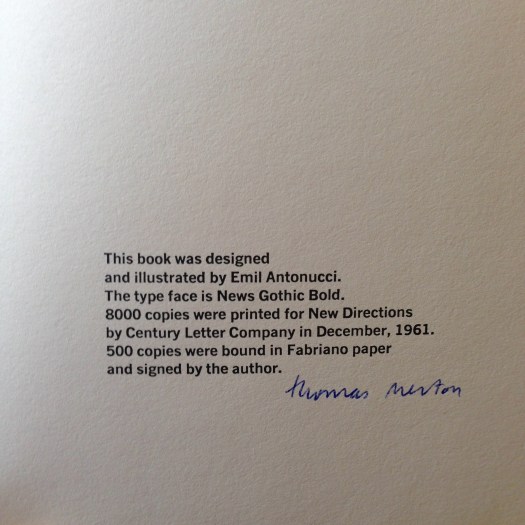
Merton, Thomas. ORIGINAL CHILD BOMB. 8000 copies were printed for New Directions by Century Letter Company in December, 1961.
Related post: “What’s on my Nightstand: January 2017”



 Leigh Hopkins




 LEIGH HOPKINS