Before I tell you what I was up to today and move on to Method 2 of the blueprint, here’s a question from one of my subscribers:
“There are countries where people have experienced genocide and other hardships way worse than what we’re going through. Are you sure we should call this a dictatorship?”
No, I’m not sure. On a technicality, this could <just> be fascism, “a government that exalts nation and often race above the individual” headed by a dictatorial individual who forcibly suppresses opposition.
UC Berkley Professor Robert Reich offers suggestions for how to manage talking about this, including the recommendation to replace T’s surname with “The GOP Administration” every time you mention him. Historically speaking, the GOP is behaving like a regime. It’s more effective to put the pressure on them. Either way, we’re witnessing the precursors to and/or direct dictatorial and fascist behaviors on a daily basis.
If you’re like me, you’repart of the 3.5%, so we’re not sitting on our hands while we wait to see what happens next. (For more reasons about why I’m using the d-word, see Jim Powell’s How Dictators Come To Power In A Democracy from Forbes magazine way back in 2013.)
Method 2: Letters of Opposition or Support
Last week, I introduced Gene Sharp’s blueprintfor removing a dictator with a list of 198 methods of nonviolent action and persuasion. Method 2 is listed as one of the “formal” actions.
Does letter-writing actually work?
If it’s part of a wider strategy, YES.
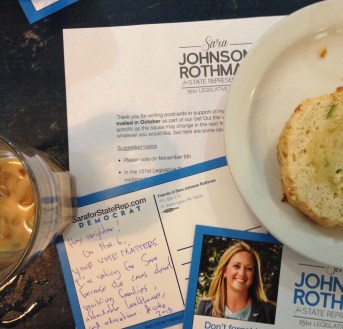
Since June, my local coffee shop has been hosting a weekly letter-writing campaign, so today I stopped by to help. When I walked in, every table was filled. As I was looking for a seat, a woman who stopped by during her lunch break offered me her seat, along with a pen, a stack of postcards, and a suggested script.
Today’s focus was on getting out the vote for the midterms by sending hand-written postcards from community members to neighbors. The event was organized by a local organization connected to the state-wide coalition Turn PA Blue.
Here’s a bit of the buzz:
Today’s Action
If your community hosts letter-writing events, go whenever you can – and keep showing up. I found mine on Facebook, so check around to see if your state has something similar. It felt good to have an outlet for my outrage, and it was inspiring to be around people who felt the same.
Until today, all of my letter-writing has been a solo act, so if you can’t find anything local just yet, here are the ACLU’s tips on writing to your representatives.
Keep it brief: Letters should never be longer than one page, and should be limited to one issue. Legislative aides read many letters on many issues in a day, so your letter should be as concise as possible.
State Who You Are and What You Want Up Front: In the first paragraph, tell your legislators that you are a constituent and identify the issue about which you are writing. If your letters pertains to a specific piece of legislation, it helps to identify it by its bill number (e.g. H.R. ____ or S. _____).
Hit your three most important points: Choose the three strongest points that will be most effective in persuading legislators to support your position and flesh them out.
Personalize your letter: Tell your elected official why this legislation matters in his community or state. If you have one, include a personal story that shows how this issue affects you and your family. A constituent’s personal stories can be the very persuasive as your legislator shapes his or her position.
Personalize your relationship: Have you ever voted for this elected official? Have you ever contributed time or money to his or her campaign? Are you familiar with her through any business or personal relationship? If so, tell your elected official or his staff person. The closer your legislator feels to you, the more powerful your argument is likely to be.
You are the Expert: Remember that your legislator’s job is to represent you. You should be courteous and to the point, but don’t be afraid to take a firm position. Remember that often your elected official may know no more about a given issue than you do.You can get the contact information for your Members of Congress at Congress.org.
On Tuesday I promised you a blueprint, and today, I’m passing it around. It’s called From Dictatorship to Democracy, A Conceptual Framework for Liberation,by Professor Gene Sharp. Sharp was the founder of the Albert Einstein Institution, a non-profit organization dedicated to advancing the study of nonviolent action. This 1994 essay is a critical analysis of how to destroy a dictatorship and to prevent the rise of a new one. It includes a list of 198 methods of nonviolent action and persuasion, found on page 79.
You’ve probably heard the expression “If you’re not OUTRAGED, you’re not paying attention.” If you’re a 3.5%er, you’ve been outraged since the summer of 2016. Dictators know that daily outrage leads to feelings of powerlessness and hopelessness. When we share our fury, while it feels good to know we’re not alone, it also means we’re doing the dictator’s job for him. This is what dictators do – whether you’re for or against them, they mobilize people around a collective energy of hatred. When weunite in a common mission for equality and peace and sustain that wave of hope, the collective energy increases our number.
Method 1: Public speeches
Every time I share a step from this blueprint, it will come with a suggested Call to Action, something immediately doable and sustainable – with the understanding that “I’m part of the 3.5%” means that when one of us gets tired, someone standing next to us will be there to pick up the torch.
Today’s Action
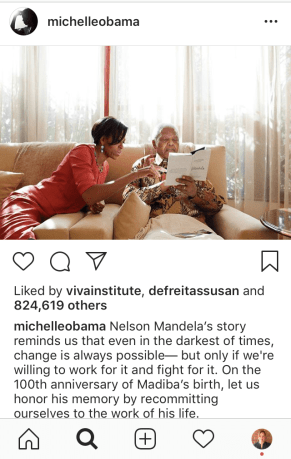
SHORT GAME: Watch and/or share any one of the speeches below, or find another one you love. (Barack Obama’s 2004 speech is one of my all-time favorites.) The power of speeches is in their ability to mobilize large groups of people, so when you share the voices from the past with your children and friends, you are reminding them that true power unites us.
Nelson Mandela said that “education is the most powerful weapon you can use to change the world.” When you talk with friends are share on social media, experiment with what happens when you shift your words to messages of empowerment.
Fill the 3.5 percenters with the inspiration needed to cancel out the noise.
LONG GAME: Be on the lookout for opportunities to attend public speeches in your community and invite your friends and family to attend. Make it a social event. Bring drinks and snacks and folding chairs. Show up in numbers. Make your presence seen and heard.
Gandhi challenged his country: “No clapping is possible without two hands to do it.” In other words: “There IS no government if the people refuse to be ruled by it.” Today, anyone with a social media account has a platform, so if your hands refuse to clap, make them click and tweet and love or like, but let all your words confirm our power.
The purpose of “The 3.5% Project” is to provide an ongoing context for Harvard professor Gene Sharp’s 198 Methods of Nonviolent Action––a blueprint for nonviolent resistance. Each of the 198 methods can be used at any time, in any order, by anyone. (Read the blog for the most recent post.) If you’re part of the 3.5%, feel free to subscribe at the top right to receive your weekly method, and please share liberally.
“Researchers used to say that no government can survive if just 5% of its population rose up against it, but what the research showed is that no single campaigns failed during the time period after they’d achieved the active sustained participation of just 3.5 percent of the population.” – Erica Chenoweth
In 2011, Erica Chenoweth and Maria Stephan published a groundbreaking study about the impact of civil resistance in the 21st Century. Chenoweth admits that she began the research as a bit of a skeptic, she felt that nonviolent action education “well-intentioned, but dangerously naive.”
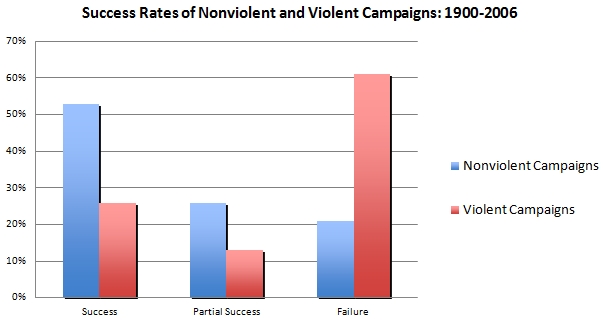
Over two years, Chenoweth and Stephan examined 323 nonviolent and violent campaigns throughout the world, all of which took place between 1900 – 2006. They focused on actions that involved at least 1,000 participants and resulted in the overthrow of a government or a territorial liberation of some kind.
What their research concluded that the nonviolent opposition campaigns were actually more than twice as successful in achieving their political objectives.
The research also showed that this trend has been increasing over time, even in those extremely brutal authoritarian conditions where the researchers expected non-violent resistance to fail.
In her 2013 TED Talk, Chenoweth said:
“Researchers used to say that no government can survive if just 5% of its population rose up against it, but what the research showed is that no single campaigns failed during the time period after they’d achieved the
active
sustained
participation of just
3.5 percent of the population.
In the US today, that’s about 11 million people. On average, non-violent campaigns were four times larger than the average violent campaign and they were often much more inclusive and representative in terms of
gender,
age,
race,
political party,
class and
urban-rural distinction.
Civil resistance allows people of all different levels of physical ability to participate.
This can include the elderly, people with disabilities, women, children and anyone who else wants to. If you think about it, everyone is born with a natural physical ability to resist nonviolently. Anyone who has kids knows how hard it is to pick up a child who doesn’t want to move or to feed a child who doesn’t want to eat.”
It turns out that there are blueprints for making this kind of thing happen. And if you’re ready to act, I’ve got a map and a flashlight.
If you’re part of the 3.5% of the population who are willing to engage in active sustained nonviolent participation, follow along.
Today the fourth episode of my ongoing series was published at Corporeal Clamor. I think of it as “Trumpian Gothic,” a love story for these strange times. I’ve woven classical music throughout, and Beethoven’s “Pathétique” is one of my favorites. I’ve included a recording of myself playing the Pathétique about halfway through the chapter, or you can watch the warm-up on Facebook.
Thanks for reading – I’ve been so appreciative of your enthusiasm for this series.
“To play a wrong note is insignificant; to play without passion is inexcusable.”
― Ludwig van Beethoven
We watch. The dog cocks a scraggy yellow ear behind him, listening for the door. Waiting, probably, for Tala to return. So we have this in common.
I kneel so slowly it’s hardly movement, but the dog drops his head and backs toward the front door, eyes locked on mine. Is it anger or fear? I don’t know dogs, and seeing as Tala has left him in my care, she doesn’t know me. I hold out my hand and his nostrils flare. He cranes his thick neck a few inches forward toward my fingers –
A muffled ring:
my body understands the sound before meaning registers, a hot surge through my arms. I shriek and the dog darts behind the couch. On the second ring, I turn and tear past piled papers and boxes and plates and books, pull the keyring from the side table drawer. On the third ring, I scramble with the tiny key, fiddle with the padlock on the door to the hidden cupboard beneath the stairs. The padlock pops, on the fourth ring, I throw open the door, duck and crawl, and as the fifth and final ring begins, I reach for the old yellow phone –


 SHORT GAME: Watch and/or share any one of the speeches below, or find another one you love. (Barack Obama’s 2004 speech is one of my all-time favorites.) The power of speeches is in their ability to mobilize large groups of people, so when you share the voices from the past with your children and friends, you are reminding them that true power unites us.




 LEIGH HOPKINS