Method 39: Parades

As I’m gearing up for a patriotic movie night with neighbors (Jaws, Lincoln, Independence Day, Hidden Figures), I thought it might help to share some ways to celebrate the best of who we are. Sending love and solidarity to all of you – with all of us pitching in, clearer skies are ahead.

About

3.5 % Project

Publications

Postage

Teaching

What’s on my Nightstand: June 2019

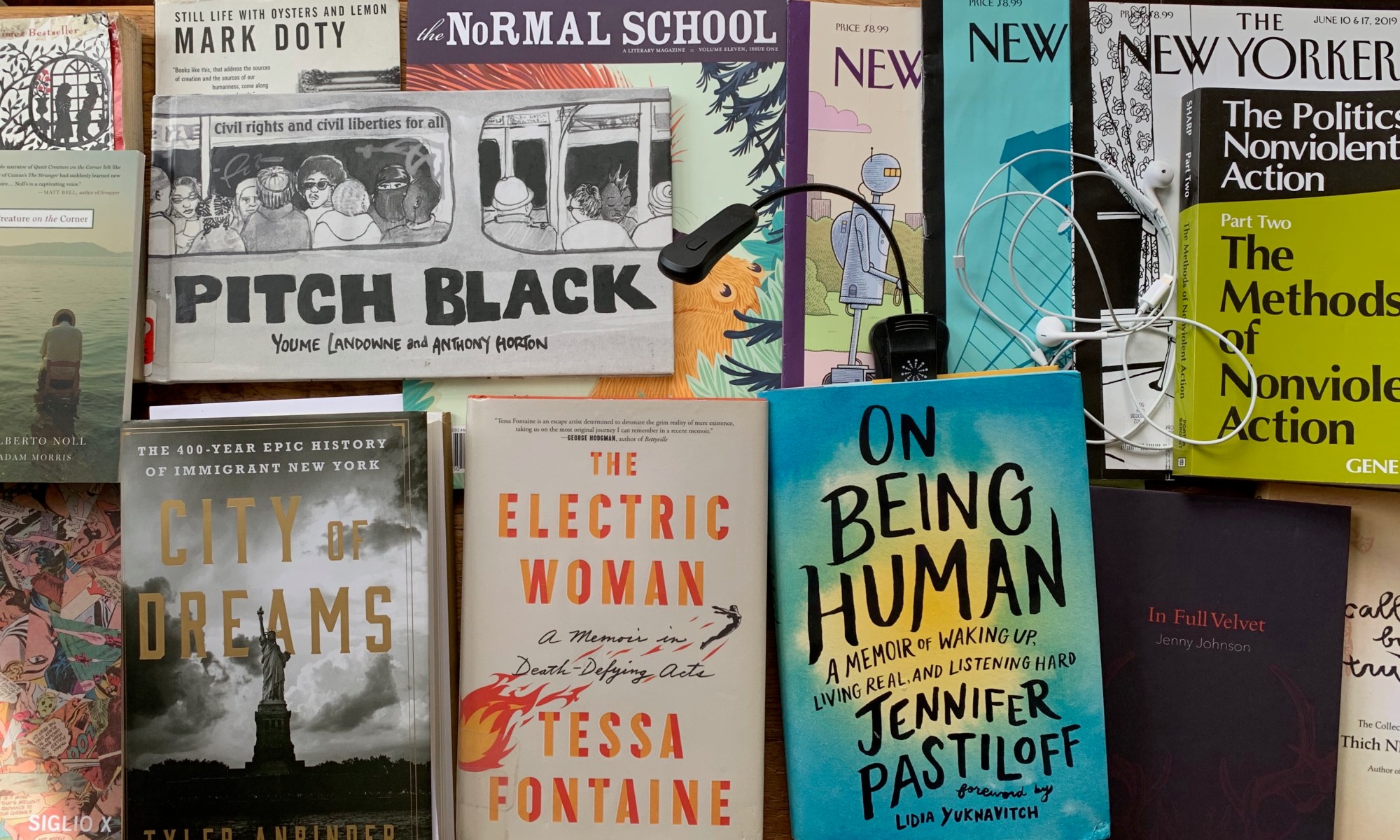
Nonfiction / Memoir

City of Dreams, by Tyler Anbinder

The Electric Woman, by Tessa Fontaine

On Being Human: A Memoir of Waking Up, Living Real, and Listening HardOn Being Human, by Jennifer Pastiloff

From Dictatorship to Democracy, Gene Sharp 

Fiction

The Monsters of Templeton, by Lauren Groff

Quiet Creature on the Corner, by João Gilberto Noll

Short Fiction

The Rule, by Frances Donnelly

Brawler, by Lauren Groff (The New Yorker)

When the Tide of Misfortune Hits, Even Jelly Will Break Your Teeth, by Porochista Khakpour (Gulf Coast)

Poetry

Still Life with Oysters and Lemons: On Objects and Intimacy, by Mark Doty

Call Me by My True Names, by Thich Nhat Hanh

In Full Velvet, by Jenny Johnson

Essay (Selected)

I am Coming for You, by Tammy Delatorre / Winning Writers

What does it mean to be a “real” mother? by Tanya Friedman / Motherwell

SHRINES. BONES. RELICS. by Anne Gudger / Equinox Poetry and Prose

The Sorrowful Mysteries, or Reasons I’m No Longer Catholic, by Kathleen McKitty Harris / Longreads

The Thread: On Justice by Marissa Korbel (The Rumpus)

I’ve Got Dreams He’ll Never Take Away; or, I Know My Childhood Molester Is Reading This. He Has Read Everything I’ve Ever Written. He’s Always Looking For His Name: It Starts with a B, by C. Russell Price

Graphic Novel

Pitch Black, by Youme Landowne and Anthony Horton

“[Landowne and Horton] collaborate here to bring Horton’s story of perseverance and hope to print, and the fluid black-and-white sequential panels tell it well. The horrors attendant on homelessness are not sugarcoated, and the language is as raw and gritty as one might expect. Powerful.”—Kirkus Reviews

On the subway, do ever notice that people are always looking, but they only see what they want to? Things can be sitting right in front of them and still they can’t see it.

Interview / OpEd (Selected)

WHY WE NEED STORIES: A PEN TEN INTERVIEW WITH SOPHIA SHALMIYEV, by Camilla Bober

Meet the power couple taking over Seattle sports (and the World Cup): Megan Rapinoe and Sue Bird, by Stefanie Loh / Seattle Times

Voices on Addiction: A Conversation with Amber Van de Bunt, by Kristen Casey / Curated by Kelly Thompson / The Rumpus

18 Questions. 21 Democrats. Here’s What They Said. The New York Times

How a Young Joe Biden Turned Liberals Against Integration, by Jason Sokol / Politico

Magazine / Newspaper

Lesbian Connection: free to lesbians worldwide, but the suggested donation is $7/issue (more if you can, less if you can’t), May/June 2019 issue

The New Yorker

The Week

TIME

The Normal School: A Literary Magazine

Random

Babo Botanicals Daily Sheer Non-Nano Zinc SPF 40 Fragrance Free Mineral Sunscreen

hydrangea blossoms

HURRAW! moonbalm

organic peach pit

About

3.5 % Project

Publications

Postage

Teaching

Method 37: Singing “Hey Baby!”

The images of the Trump Baby balloon flying over London all week have made me downright jolly. Sky News even released a promo video that feels like the trailer of a horror movie.

The citizens of Brighton made great use of Method 37 during Trump’s first visit to the UK in 2017. The melody the of 1961 classic, “Hey Baby!” is a popular football chant, but in the new anti-Trump rally cry, protestors sang:

“Hey Donald Trump (oooh, ah!)
I wanna know why you’re such a c*nt!”

Singing has a long history as an effective method of nonviolent action. Protestors have burst into song to interrupt unwanted speeches or to spread ideas during marches or public events. Zen master Thich Nhat Hanh has written about the use of singing during the Buddhist struggles in South Vietnam in 1963:

Political satirical songs are easy to learn by heart and can be circulated very quickly. They were widely used during the struggle against Ngo Dinh Diem [who was ousted as head of the government in 1963]. There were hundreds of them. The most famous was “nghe ve, nghe ve, nghe ve, Nhu Diem”, a song dealing with the corruption of that regime.

The Specials’ song Free Nelson Mandela was released in 1984 as part of the bloodless revolution that ended apartheid in South Africa in 1990. Listen and imagine the rallying, unifying effect of such a buoyant sound. To read more examples of Method 37, see my Instagram post about an event that occured during Nazi-occupied Poland eight months before D-Day.

In the midst of my Trump Baby glee, this anniversary is a grim reminder that democracy is not something we can take for granted.

About

3.5 % Project

Publications

Postage

Teaching

Method 36: Nancy Pelosi, Goddamn

“What the hell is it going to take, Democrats?!”

That’s what NY Times columnist Charles M. Blow is asking. Yesterday morning, after two years of silence, Robert Mueller made a very brief public appearance in which he declined to clear Trump of any involvement in Russia’s interference in the 2016 election.

“And as set forth in the report after that investigation, if we had had confidence that the president clearly did not commit a crime, we would have said so. We did not, however, make a determination as to whether the president did commit a crime.”

– Robert Mueller, May 29, 2019

That Trump wasn’t indicted was not a matter of the evidence, but of Department of Justice policy, which prohibits prosecuting a president. Trump is tweeting out his innocence and the administration taking advantage of every loophole it can find. Meanwhile, as I’ve been fearing for two years, the GOP cronies are coming out of the woodwork. Two weeks ago, Alabama passed a near-total abortion ban, and as of yesterday, Louisiana’s headed in the same direction.

Today’s method calls for some Nina Simone…and I mean every word of it.

The name of this tune is Mississippi goddam
And I mean every word of it
Alabama’s gotten me so upset
Tennessee made me lose my rest
And everybody knows about Mississippi goddam

“Mississippi Goddam! — The Song that made Nina Simone into a Revolutionary,” by Chika Dunga, Medium

What’s on my Nightstand: May 2019

Nonfiction / Memoir

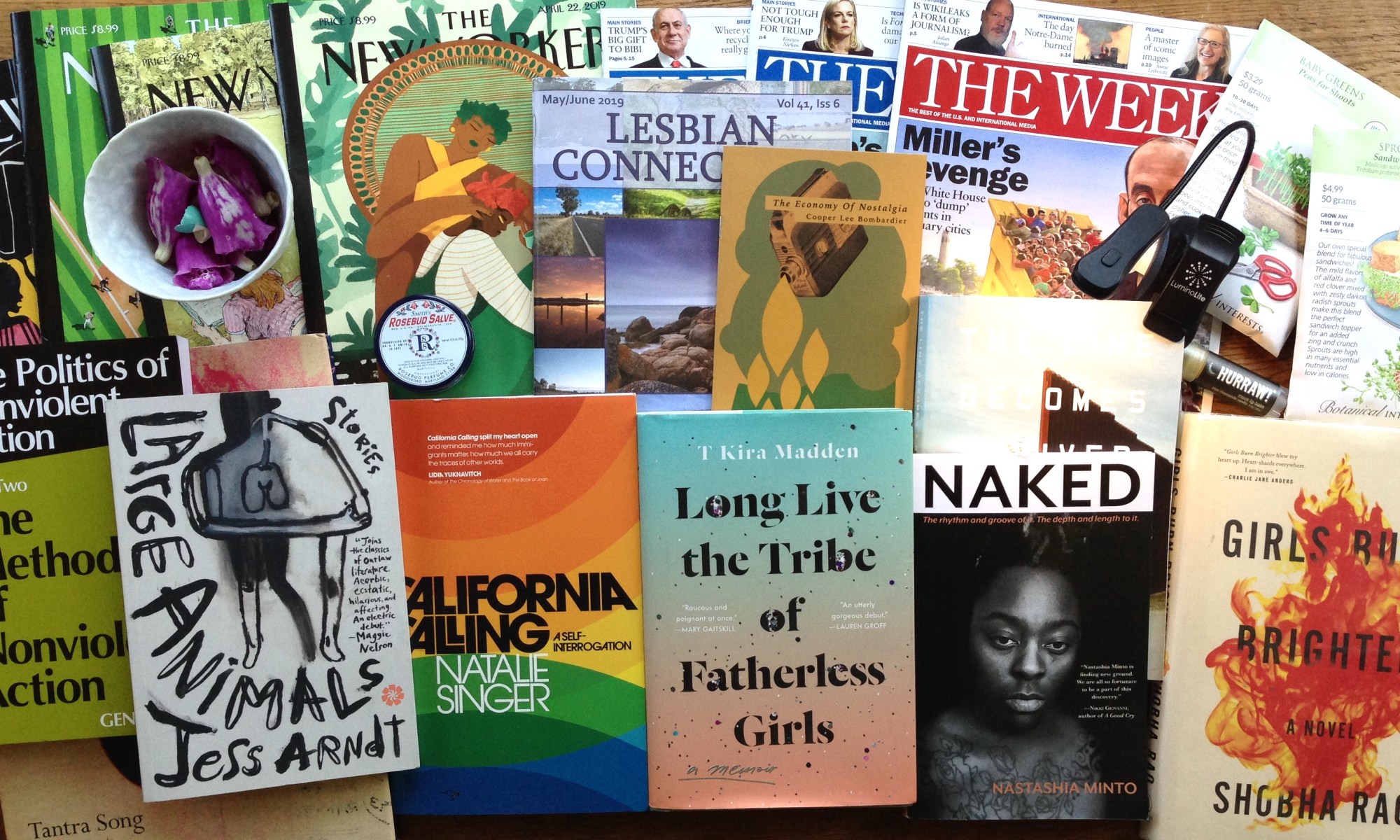
The Line Becomes a River: Dispatches from the Border, by Francisco Cantú

Long Live the Tribe of Fatherless Girls, by T Kira Madden

California Calling, by Natalie Singer

From Dictatorship to Democracy, Gene Sharp 

Fiction

Girls Burn Brighter, by Shobha Rao

Short Fiction

Large Animals, by Jess Arndt

Brawler, by Lauren Groff (The New Yorker)

When the Tide of Misfortune Hits, Even Jelly Will Break Your Teeth, by Porochista Khakpour (Gulf Coast)

Breeding Season, by Amanda Niehaus

Poetry / Chapbook

Elizabeth Bishop: The Complete Poems: 1927 – 1979

The Economy of Nostalgia, by Cooper Lee Bombardier

Naked, by Nastashia Minto

Essay (Selected)

Don’t Use My Family for Your True Crime Stories, by Lilly Dancyger (Crime Reads)

Percolations, by Daniel Elder (Entropy)

Is Masculinity a Terrorist Ideology? by Lacy M. Johnson (LitHub)

The Thread: The Stories We’ve Been Told by Marissa Korbel (The Rumpus)

Voices on Addiction: Fault Lines, by Lauren Marker (The Rumpus)

Interview / OpEd (Selected)

How Trump has already changed immigration policy, by Joshua Barajas (PBS News Hour)

Psychogeography of Abandonment: An Interview with Sophia Shalmiyev, by Cooper Lee Bombardier (BOMB Magazine)

What Can the U.S. Learn From How Other Countries Handle Immigration? by  and 

Interview: Nastashia Minto, editor Katie Collins Guinn (NAILED)

This Gen X Mess, by Lisa Frank (The New York Times)

Why Aren’t the Democratic Presidential Candidates Talking About Immigration More? by Onita Nwanevu (The New Yorker)

Letters to Mothers: Crones, Hags, Witches, and Killjoys, by Sophia Shalmiyev and Leni Zumas (Guernica)

How ‘I got a plan’ became a thing: Warren nerds out and the crowds go crazy, by Alex Thompson (Politico)

Magazine / Newspaper

Lesbian Connection: free to lesbians worldwide, but the suggested donation is $7/issue (more if you can, less if you can’t), January/February 2019 issue

The New Yorker

The Week

TIME

SIERRA Magazine

Random

Rosebud Lip Salve

seed packets, pea shoots and mixed sprouts

ceramic bowl, Paula Winokur

foxglove blossoms

robin’s egg

HURRAW! moonbalm

About

3.5 % Project

Publications

Postage

Teaching

Method 33. Fraternization: Stay connected or steer clear?

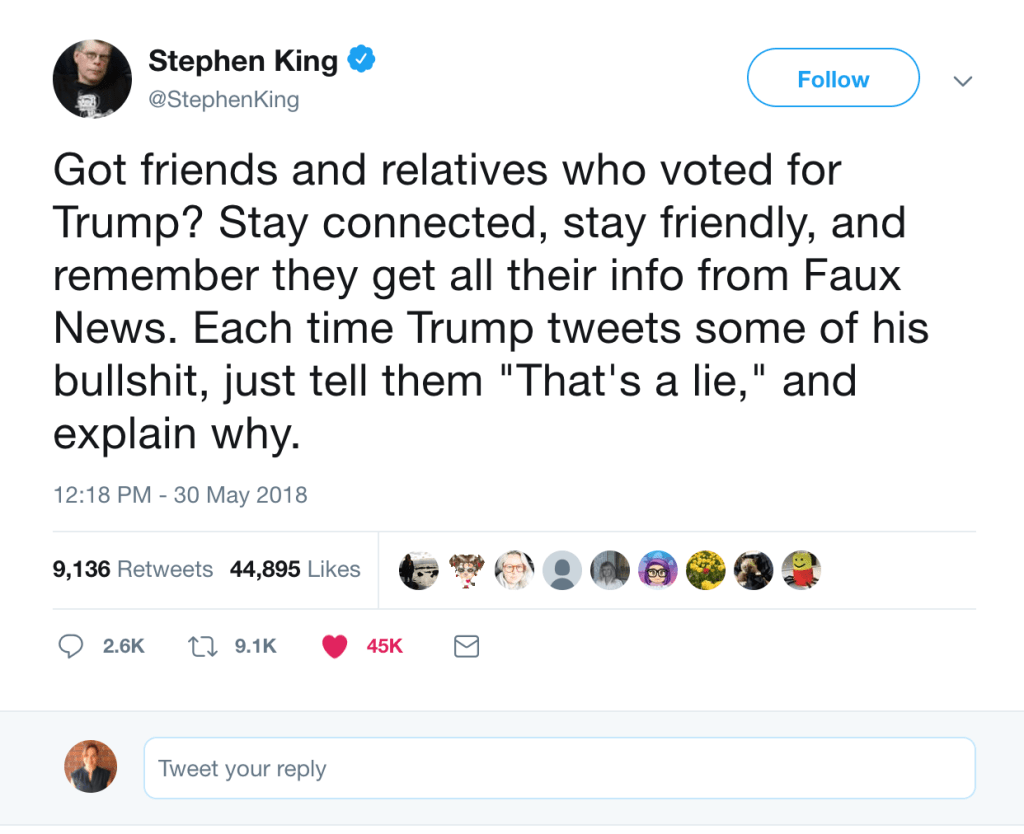
One of the hard questions many of us have been asking ourselves: “Should I stay friends with Trump supporters?” My gut says save yourself the heartache, but nonviolent action theory says YES – and so does Stephen King.

King has also called Trump a “nut job” and wrote that the president’s access to the nuclear codes “worse than any horror story I ever wrote.” So there’s that.

I asked friends on Facebook to tell me about a conversation they had with a 45-loving family member or friend that went WELL, and here’s what I got:

  • It would be an imaginary tale.
  • I think all of my in-laws voted for him. It’s put a strain on our relationship
  • Oh I’ve unfriended both friends and family members over this floridfacedfatfuck
  • My brother 🙄. We don’t talk about it. My mom is just anti-democrat but falls short of Trump-loving. I will way that she is appalled, surprised, and receptive when I show her news not available on Fox
  • I WOULD have a conversation, but have to spit whenever that name is mentioned. It always seems to go back to what Obama did or didn’t do.
  • every time i’ve tried it’s just turned into a never ending tire fire.
  • When can I stop laughing? They’re all gone.

I’m fessing up. I’m writing about the importance of building bridges, but I fully admit that I screen all of my contacts on social media for any whiff of Trump. I know that my uncle has called Trump “the best president of my lifetime,” and I admit that I don’t mind so much that I haven’t seen him since the election. It’s not like these conversations are out of my comfort zone – I’m a liberal lesbian Democrat and I managed to work with the Bush administration – but this is something different.

So here’s a gut check: the research shows that keeping the communication lines open is vital component of successful nonviolent resistance. Gene Sharp’s research showed that an effective alternative to boycotting soldiers and police is to:

  1. befriend them and convince them that hostility is not part of the resistance;
  2. convince them that the objects of the regime are immoral and unjust;
  3. to convince the opposition to resist or refuse to carry out orders;
  4. to convince the opposition to provide information to the resistance about the oppressor’s plans.

In 1915, Gandhi demonstrated that “befriending one’s enemy” worked to change opinions about the untouchables in India. In the Hungarian Revolution in 1956, revolutionaries made deliberate efforts to befriend Russian soldiers, and “something like a bond of sympathy” arose, leading soldiers to align with Hungarians.

In March 2011, Syrian activist Islam al-Dabbas, known locally as “The Flower Guy,” led his fellow protesters in bringing water and flowers to the army and security forces that were trying to end demonstrations. He’s now serving 15 years in prison. “We wanted to send a message: these protests are peaceful,” said his brother Mohamed. “My father and brother did nothing more than peacefully ask for justice and freedom.”

Can a democracy survive the kind of polarization we’re experiencing? I’ll be writing about that in future posts. In the meantime, if you’ve managed to keep a friendly relationship with Trump-supporting family and friends, hit me up in the comments.

3.5% Project

About

Publications

Subscribe

What’s on my Nightstand: March 2019

Nonfiction

Deep Creek: Finding Hope in the High Country, by Pam Houston

The Way of Chuang Tzu, by Thomas Merton

Era of Ignition, by Amber Tamblyn

From Dictatorship to Democracy, Gene Sharp 

The Methods of Nonviolent Action, by Gene Sharp

Occasional Magic – The Moth (True Stories About Defying the Impossible)

Fiction

The Queen of the Night, by Alexander Chee

Before She Was Harriet, by Lesa Cline-Ransome

Short Fiction

‘The Office of Missing Persons’ by Akil Kumaraswamy (Lit Hub)

‘The Frog King,’ by Garth Greenwell (The New Yorker)

‘Motherland,’ by Min Jin Lee (The Missouri Review)

Poetry

Elizabeth Bishop, The Complete Poems: 1927 – 1979

Enough Music, by Dorianne Laux

Goodbye to Tolerance, by Denise Levertov

Essay / Interview / OpEd (Selected)

The Phenom: ‘Change Is Closer Than We Think.’ Inside Alexandria Ocasio-Cortez’s Unlikely Rise,’ by Charlotte Alter

8 Short Kids’ Films Every Mini-Feminist Should See, by Emma Davey

Thesomorphia, by Melissa Febos

The Thread: Down Girl (The Rumpus) by Marissa Korbel

Against Catharsis: Writing is Not Therapy, by T Kira Madden

Voices of Addiction: All the Ways to Save Your Life,(The Rumpus) by David M. Olsen

Patti Smith discusses activism in the age of Trump: ‘I’m not going down with the ship, that’s for certain’ by Randall Roberts

AACK! Cathy Guisewite made a wildly successful comic strip by and for women. But to her critics, she’s just another example of compromised feminism by Rachel Syme

Magazine / Newspaper

Lesbian Connection: free to lesbians worldwide, but the suggested donation is $7/issue (more if you can, less if you can’t), January/February 2019 issue

The New Yorker

The Week

TIME

SIERRA Magazine

Random

booda butter – naked lip balm

El Sueño Americano (The American Dream) – exhibition card, Tom Kiefer

abalone shell, palo santo wood, dried rose buds

Chill Pill – Aura Cacia Essential Oil Blend

necklace (shells, leather suede), Little Green Apple Jewelry

beach stones

Mexican tile (coaster)

About

3.5 % Project

Publications

Postage

Teaching

Method 31: “Haunting” Officials

Sometimes I wonder what it will feel like to read these posts in 5 or 10 years. Honestly, I started the this project because I needed to do something with the daily barrage of overwhelmingly bad news. In a short time, it’s becoming a record of how much we’re all managing on a daily basis.

I am doing this because we are NOT helpless.

These methods work.

Method 31: “Haunting” Officials was used in India 1928 during the Bardoli Satyagraha, a peasant-led campaign of civil disobedience. In response to the government’s unresponsiveness to widespread famine, farmers, peasants, and other volunteers “haunted” government officials. They camped out in the roads in front of their homes in silence. When the activists were arrested, they were immediately replaced by others. Eventually, authorities tired of the process. Members of the governments of Bombay and across India were furious about the treatment of the protesting farmers and resigned from their offices in open support of the farmers.

Yesterday in New Zealand, citizens gathered in silent protest outside Gun City, a gun store that sells the military-style semi automatic reportedly used by the man responsible for the massacre in Christchurch. Prime Minister Jacinda Ardern’s response to the massacre puts other leaders to shame:

“She fought from the start like a real politician, scorning the killer, attacking racism and slapping back at Turkish president Erdogan’s revolting election propaganda – which used the murderer’s own video – then hitting out at US president Trump. And insisting that New Zealand’s gun laws would change forever.”– Robert Fisk, Independent

Got a tent? Pitch it here.

I’ll bring snacks.

Mueller, please hurry up.

3.5% Project

About

Publications

Subscribe

Method 30: Rude Gestures

Wasn’t Method 29 a breath of fresh air? Today’s must-watch video of Anderson Cooper is not that. The piece below aired last week, but in today’s news cycle, it’s already old news. That’s the danger of the time we’re in. Paul Manafort is up for sentencing today, 45 is already tweeting about campaign contributions and the wall, and in the meantime in North Korea:

Satellite images appear to show the North is rebuilding a facility that had been previously used to test long-range missile engines. Analysis of the images suggests the work on the facility, which had been dormant since August, began right around the time Donald Trump and North Korean leader Kim Jong Un met up for their second summit, which ended last week without an agreement. 

– via CNN, March 6, 2019

Watch Anderson Cooper’s response to 45 calling Kim Jong-un, the leader of the world’s most repressive dictatorship, “my friend,” “an interesting guy” and a “real leader.” North Korea – the country where failing to keep the presidential portrait dust-free is a punishable offense.

This offers some context for Professor Gene Sharp’s warning that Method 30 should be used only rarely in situations of political or international conflict. What would happen if North Koreans mooned Kim Jong-un’s palace, like Trump’s protestors did in Chicago? By law, three generations of a protestor’s family could be sent to labour camps.

In September 2017, The Telegraph provided a concise list of “brutal and inhumane laws North Koreans are forced to live under.” I’ve provided a condensed version, below:

Three generations rule

In North Korea, if one person is convicted of a serious crime and sent to a prison camp, their immediate family can also be sent with them. Then the next two generations born in the camps can also remain there. The 1972 edict says that up to three generations must be punished to wipe out the ‘seed’ of class enemies.

Access to non-state-controlled media

Listening to unauthorized foreign broadcasts, watching foreign TV shows and possessing dissident publications are considered “crimes against the state.” Those caught face execution or being sent to labour camps.

Freedom of movement

It is a criminal offense for North Koreans to leave the country without government permission. That doesn’t stop thousands making highly treacherous journeys in attempts to escape every year. Even those who successfully make it out of the North can still be pursued by government agents and there are reports of defector’s families being punished in their absence.

Practising Christianity

Although the North Korean constitution officially allows freedom of religion, the state has a hostile approach to religions, particularly to those it sees as western faiths such as Christianity. Those discovered practicing Christianity face arrest and being sent to a labour camp. (I wonder how the half of pastors who approve of Trump feel about the endorsement of Kim Jong-un?)

Economic rights

Private enterprise of any kind is officially banned in North Korea. Those caught face arbitrary punishment even though the black market remains one of the only ways for people to get the food, medicine and other necessities the government often fails to provide. 


Mueller, please hurry up.

3.5% Project

About

Publications

Subscribe